Knossos Palace Percy Jackson-Themed Private Tour with Licensed Guide
Short Description:
Step into Greek mythology with a Percy Jackson-inspired private tour of Knossos Palace. Designed for families and fans of mythology, this engaging experience follows the legends of the Minotaur, King Minos, and Theseus—brought to life by a licensed guide.
Full Description:
Follow in the footsteps of ancient heroes and modern demigods with this unforgettable Percy Jackson-inspired private tour of Knossos Palace, where myth and history collide in spectacular fashion.
Guided by a licensed expert—your very own Ariadne through the Labyrinth—you’ll dive deep into the world of Greek mythology, uncovering legendary tales such as Theseus and the Minotaur, the tragic story of King Aegeus, and the secrets of King Minos’ Palace.
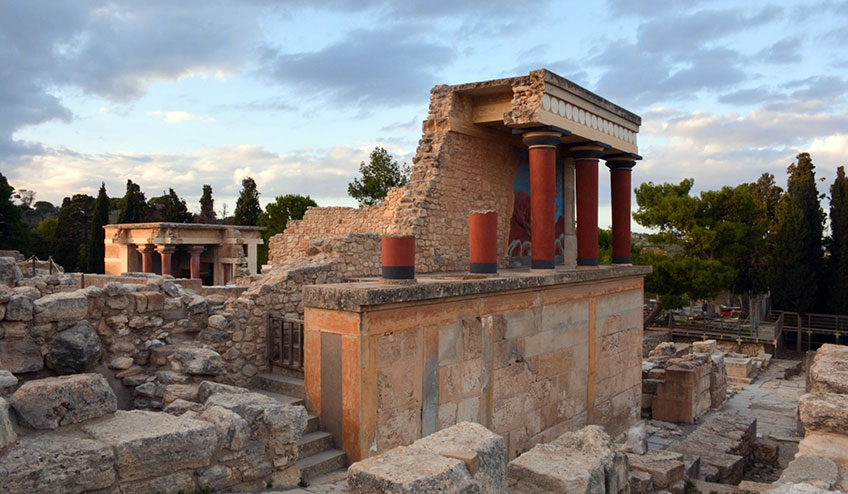
As you wander the sprawling 20,000 m² ruins of Knossos, you’ll explore the very settings that inspired countless myths:
- The Throne Room of King Minos, Europe’s oldest known royal seat
- The beautifully decorated Dolphin Apartment of Queen Pasiphae
- The ancient ceremonial path said to be walked by the Athenian youths sent to face the Minotaur
- The intricate palace layout that inspired the legend of the Labyrinth itself
This tour brings the mythology behind the stones to life. Through lively storytelling and theatrical flair, your guide paints vivid scenes of gods, monsters, and heroes—making it feel as though Percy Jackson, Annabeth, and Grover might leap out from around the next corner.
With references drawn from Rick Riordan’s beloved novels, your experience is crafted to both entertain and educate. It’s perfect for:
- Families seeking an engaging introduction to Greek mythology
- Young travelers who love Percy Jackson
- Adults with a passion for ancient stories and epic quests
Feel the myths under your feet, breathe in the history, and stand where legends once roamed.
You’ll leave with more than just facts—you’ll carry the echoes of ancient tales and heroic footsteps that shaped Western storytelling for millennia.
Product Highlights:
- Private mythology-themed tour of Knossos Palace
- Based on the Percy Jackson universe and Greek legends
- Visit the Labyrinth of the Minotaur, Throne Room, and Queen Pasiphae’s chamber
- Follow Theseus’ mythical path from Athens to Crete
- Led by a licensed English-speaking guide skilled in storytelling
- Perfect for kids, families, and lovers of mythology
- Skip-the-Line Entry and check-in assistance included
Inclusions:
- 90-minute private guided tour
- Licensed English-speaking guide
- On-site check-in support at the WeGuide.gr – Meeting Point
- Mythology-inspired storytelling throughout the visit
- Skip-the-Line service (entry ticket not included unless booked as package)
Exclusions:
- Entry ticket to Knossos Palace (available as an add-on, €20 per adult 18+; free for citizens under 18, with valid ID)
- Hotel pickup and drop-off (available as an add-on)
- Food and drinks
- Tips and gratuities
Meeting Point:
Palace of Knossos – Main Entrance
In front of the official Ticket Office.
Look for the “WeGuide.gr – Meeting Point” sign held by our representative.
Important Info:
- This tour involves moderate walking on uneven surfaces
- Not wheelchair accessible
- Bring sun protection and water, especially in summer
Meeting Point
We are in front of the main gate of Knossos Palace
Theseus and the Minotaur
Androgeus, son of Minos, had been killed by the Athenians, who were jealous of the victories he had won at the Panathenaic festival. Others say he was killed at Marathon by the Cretan Bull, his mother’s former taurine lover, which Aegeus, king of Athens, had commanded him to slay. The common tradition is that Minos waged war to avenge the death of his son and won. Catullus, in his account of the Minotaur’s birth, refers to another version in which Athens was “compelled by the cruel plague to pay penalties for the killing of Androgeos.” Aegeus had to avert the plague caused by his crime by sending “young men at the same time as the best of unwed girls as a feast” to the Minotaur. Minos required that seven Athenian youths and seven maidens, drawn by lots, be sent every seventh or ninth year to be devoured by the Minotaur.
When the third sacrifice approached, Theseus volunteered to slay the monster. He promised his father, Aegeus, that he would put up a white sail on his journey back home if he was successful, but would have the crew put up black sails if he was killed. In Crete, Minos’ daughter Ariadne fell madly in love with Theseus and helped him navigate the labyrinth. In most accounts she gave him a ball of thread, allowing him to retrace his path. Theseus killed the Minotaur with the sword of Aegeus and led the other Athenians back out of the labyrinth. On the way home, Theseus abandoned Ariadne on the island of Naxos and continued. He neglected, however, to put up the white sail. King Aegeus, from his lookout on Cape Sounion, saw the black-sailed ship approach and, presuming his son dead, committed suicide by throwing himself into the sea that is since named after him. This act secured the throne for Theseus.
The Minotaur and Knossos palace
The Greek legend of the Minotaur and the city of Knossos have long been the subjects of artistic fascination. Merging history, mythology, and art, we take a closer look at the legacy of the Minotaur in art.
The origins of the Minotaur, half bull and half man, lie in the ruins of Knossos; the main city of the bronze Minoan civilization in the Greek island of Crete. A mixture of fact and mythology, this ancient civilization revered the monstrous bull-like creature, and there are many remnants of its presence in Minoan culture. A bust of the Minotaur can be seen in the National Archaeological Museum in Athens.
The monster was believed by the Minoans to have lived below the palace of King Minos in a dark labyrinth. This labyrinth was designed by Daedalus, so skillfully that no one could ever escape. The Minotaur lurked among its dark passages waiting to attack his victims. No one ever left the labyrinth alive.
One idea is that the labyrinth could have been based on the plan of the building. Perhaps there was a labyrinth underneath the palace, but no evidence has yet been found. The plan of the palace itself looks like a labyrinth, and some archaeologists have suggested a connection.
The origin of the Minotaur may also be based on geographical location, as Knossos lies in the center of an earthquake zone. The earthquakes’ roaring sound was rumored to be made by a great roaring bull below the palace, creating loud quakes.
Of the many stories of the Minotaur, there is the famous legend that once a year the people of Athens had to send seven boys and seven girls to be fed to the Minotaur. One year Theseus, son of Aegeus the King of Athens, offered to take his place among the young men. He devised a plot to kill the Minotaur.
When Theseus arrived at Knossos, Ariadne, the daughter of King Minos, fell in love with him. She gave Theseus two gifts, a sword to kill the Minotaur and a ball of thread. Ariadne told Theseus to fasten one end to the entrance of the labyrinth, hold the ball and after he had killed the Minotaur he could find his way swiftly back to daylight by following the thread.
Images of the bull and Minotaur were very popular in Minoan times and the modern day depiction of the Minotaur is borrowed from Minoan artistic creations. The Minoans were a peaceful, trade faring civilization, as well as being rich and advanced.
The Minotaur is not fully human, animal or God. The ambiguity of the figure places him outside the bounds of morals and reason. Images and stories of the Minotaur still influence European writers and artists.
An example of this monstrous creature in modern Greek art can be seen in the 1961 work Theseus with Founstanella and the Minotaur by the artist Nikos Engonopoulos.
One artist who deeply explored the subject of the Minotaur in his work is Pablo Picasso. Some of his work show the Minotaur as violent; a rapist and a murderer. In other works, he is depicted as a lover rather than a monster, appearing to be in a consensual relationship with women. In some paintings he draws directly on the homage to the myths of Theseus and the Minotaur and also the Minoan tradition of bull-leaping.